


By Sean Moudry
When you’re looking for the right brokerage, it’s easy to get confused with all the different splits and fees. Every company seems to promise the “best deal”… 70/30, 80/20, or 100% commission split, monthly fees, Caps, transaction fees, and franchise fees, it’s dizzying!
The truth is for most agents, the right compensation model isn’t just about who takes the smallest cut. It’s about which model gives you the most value for what you pay and helps you build the career you actually want.
Brokerages have designed their compensation models to appeal to specific kinds of agents. Some target new agents that are hungry for training and mentorship. Others go after seasoned producers who crave independence. Once you understand how these models work, you’ll see which one truly fits where you are in your business, and where you’re headed next.
Here are the most common Brokerage Compensation Models today:
Transaction-Fee or “Flat-Fee” Models: Built for Self-Starters
If you’ve ever seen an ad for a brokerage that lets you “keep 100% of your commission,” it’s probably a transaction-fee model. These brokerages charge a small monthly fee, often between $50 and $100 a month, plus a flat fee per closing, usually between $350 to $500. You pay for everything else yourself: leads, marketing, training, E&O insurance, even office space.
For the right person, this can feel like freedom. You have complete control, minimal overhead, and maximum payout on each deal. If you already have a solid pipeline, decent technology, and confidence in your skills, this structure can save you money.
But there’s a catch: you’re on your own. You won’t get any leads, you won’t get coaching, and if you need accountability or systems, you’ll have to find them or build them yourself. The model works best for highly independent agents or those who treat real estate as a part-time side business. It’s lean and flexible. But it’s only successful for those that already know how to generate consistent income.
Traditional Split Models: Ideal for New Agents Who Want Full Support
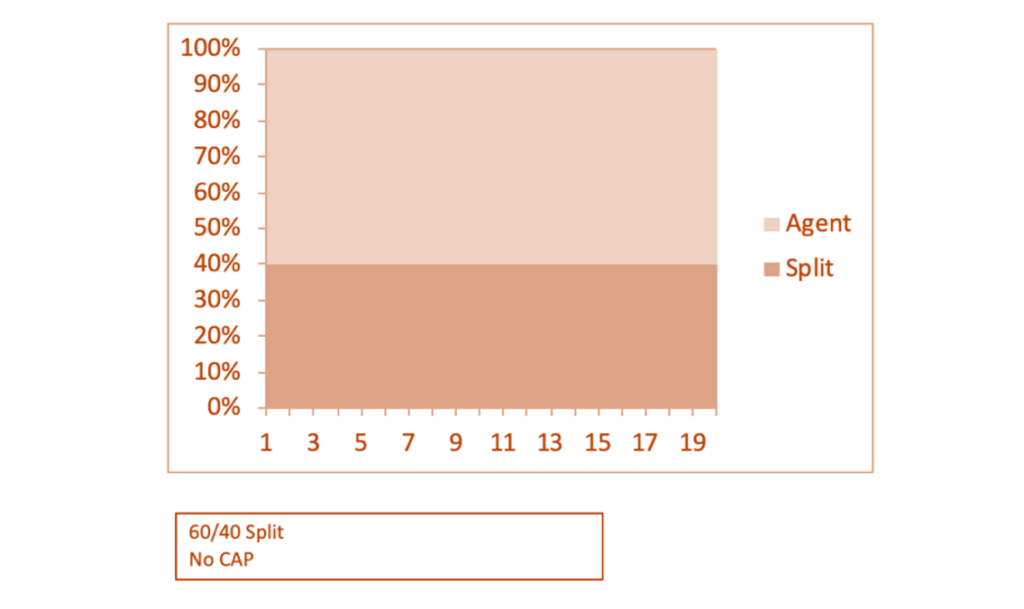
Traditional split models are what most people think of when they picture a classic brokerage. You might see a 60/40 or 50/50 split. Where you keep 60% of the commission and the brokerage keeps 40%. In exchange, the company typically covers the big-ticket items: branding, listing marketing, office space, and even leads. Think boutique brokerages.
For brand-new agents, this can be an incredible launchpad. You get guidance, a solid brand to partner with, hands-on mentorship, and a safety net while you learn the ropes. If you’re doing only a few deals a year, the higher split you pay to the brokerage doesn’t hurt much, because the value you get back in training and support is worth it.
However, as your production grows, you’ll start to feel the sting. Once you’re closing consistent business, giving up 40%, or more, of every check is expensive. That’s why most agents who start in a traditional model eventually outgrow it. The same system that protected you early on can hold you back later.
If you’re an agent who prefers an established brand, direct oversight, and a close relationship with your broker, this model may serve you well. But when your volume increases and you crave more freedom or income, it may be time to graduate.
Graduated Split Models: Rewarding Growth and Loyalty
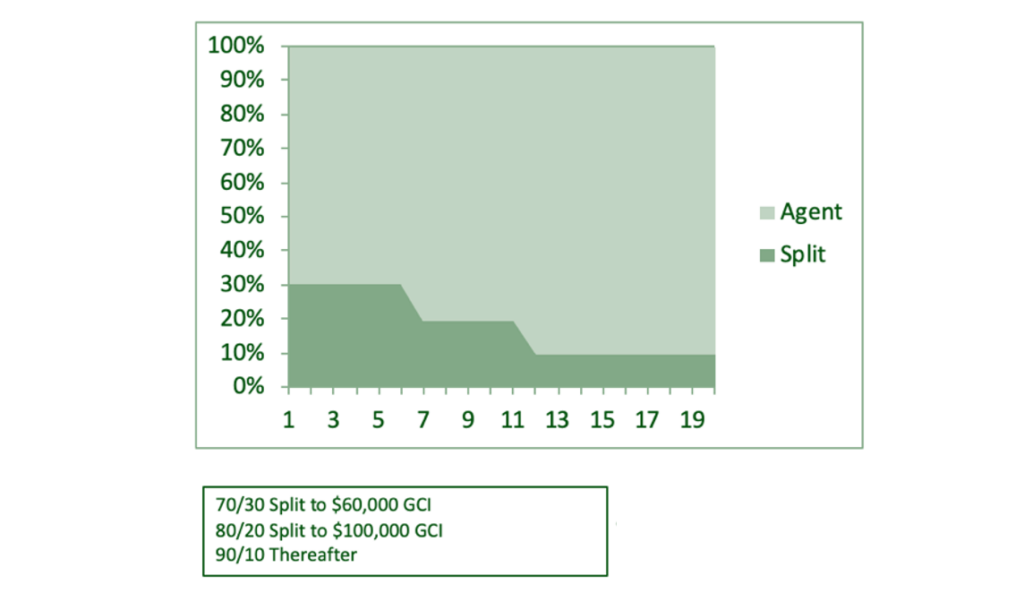
To keep agents from leaving once they become successful, many brokerages use a Graduated Split. Where you might start at a 70/30 split, but as you hit certain production goals, say $60,000 GCI (Gross Commission Income), you move to 80/20. Hit $100,000 GCI and you bump to 90/10 for the rest of the year. In this model you never actually reach a true 100%.
This model rewards growth. The more you produce, the more you keep. It’s motivating, especially if you’re climbing from mid-level to high-level production. You can literally see your split improving with every sale.
The graduated model also creates loyalty. You’re less likely to leave when you know your next closing could push you into a better tier. However, these systems can be complex to track, and the “reset” each anniversary year can feel discouraging when you go back to the lower tier.
Still, if you’re in the growth phase of your business and you want a clear path to earning more without leaving your brokerage, this model can keep you focused and rewarded.
Capped Models: The Best of Both Worlds
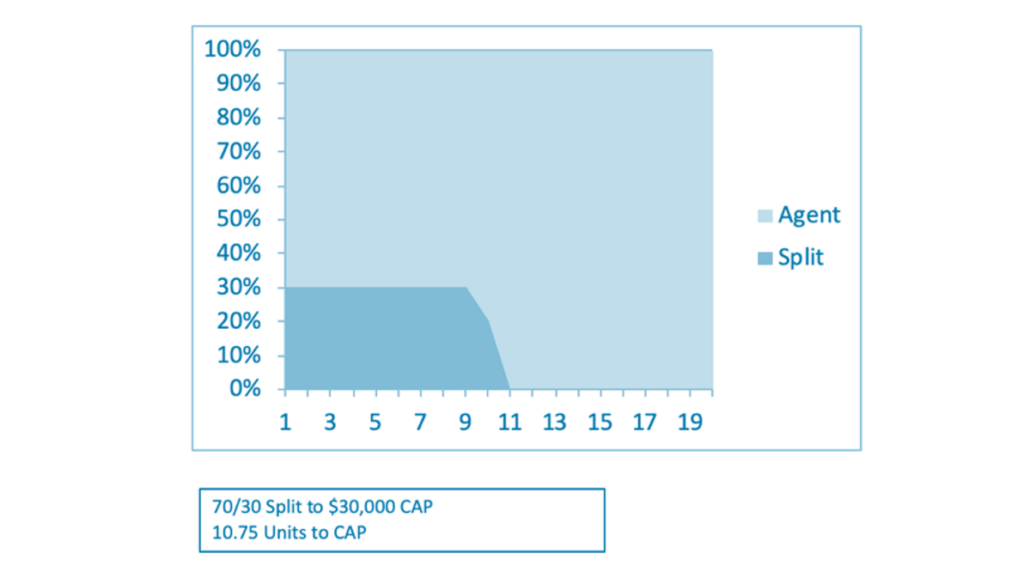
Now let’s talk about the model that’s changed the game for agents across the industry: the Capped Model. Here’s how it works. You share a percentage of each commission (often starting at 70/30) until the total amount you’ve paid the brokerage reaches a set annual maximum, or “Cap.”
Once you hit that Cap, say $18,000-24,000, you keep 100% of your commissions for the rest of your anniversary year. This model has become the standard for many brands because it’s fair, flexible, and scalable. It also rewards growth and encourages loyalty.
If you’re new, you start on the same split as everyone else, but with a clear ceiling. If you’re a top producer or a team leader, you can reach your Cap quickly and enjoy several months of 100% commission income.
Unlike the flat-fee brokerages, you’re not isolated. You still get access to support, training, coaching, and community. On the other-hand… unlike the traditional model, you’re not punished for succeeding. Once you hit your cap, you get to keep it all!
For many agents, this is the balance between autonomy and structure, freedom and support.
Monthly-Fee Models: Predictable, but Risky for Lower Producers
The monthly fee model is similar to a landlord and tenant relationship. The brokerage (landlord) provides all the necessary services the agent needs to be successful with their real estate career in exchange for a fixed monthly fee (between $1000 and $1200 a month). The agent (tenant) pays for additional features and services like training, marketing, private office, and transaction coordination separately.
For high-volume producers, this is predictable and often more profitable. You know exactly what you’ll pay each month, regardless of how much you sell. But for agents who are still inconsistent, or seasonal, it can be risky. If you have a slow month, that $1,200 still comes out of your account!
This model tends to attract seasoned agents with an established client base. It offers stability for the broker and control for the agent. But it can also create an aging agent population, as newer agents rarely have the resources to commit to fixed monthly costs.
If you’re at the point where you want to treat your business like a full-scale operation, and you can comfortably handle a steady expense load, this model might suit you. Otherwise, the capped structure usually provides the same benefit without the same risk.
Additional or Hidden Fees

Most brokerages charge more than just the commission split you see on paper. In addition to the brokerage split, many companies have a Franchise Fee that’s paid to the parent company on every transaction. Depending on the brand, this can either be a small percentage of the commission, usually between 5% and 8%, or a Transaction Fee deducted from your commission at each closing.
Franchise Fees go toward national advertising, brand support, and corporate infrastructure. While they’re common across franchise systems like RE/MAX, Coldwell Banker, and Keller Williams, at many brokerages like Compass, EXP and real (that are not franchises) they are just called a Marketing Fee, Broker Review, or Transaction Fees.
Understanding how and when Franchise Fees are charged is key to comparing your true net income between brokerages.
Which Model Is Right for You?
Here’s the reality: different models fit different stages of your career.
- If you’re New, focus on support, mentorship, and culture… not just your split. A traditional or capped model with strong training will help you ramp up faster than chasing a 100 percent promise with no guidance.
- If you’re Mid-Level, look for transparency and growth. A graduated or capped model lets you see exactly what you’ll pay and what you’ll earn as you improve.
- If you’re a Top Producer, focus on scalability. The best brokerages for top producers provide systems, staff, and leverage. Not just higher splits. You want a structure that rewards success without limiting expansion.
What’s most important is finding a brokerage that grows with you, not one you’ll have to leave once you level up. That’s where Keller Williams Advantage stands apart.
How Keller Williams Advantage Balances Splits, Caps, and Franchise Fees
At Keller Williams Advantage (KWA), you operate under a true 100% Capped Model. New agents start on a 70/30 split, however like the Graduated Split model, as you sell more, your split improves to a 80/20, or even a 90/10.
Like other Capped Models, each agent has a Cap paid to the office. But what makes KW truly different is the Cap on Franchise Fees (“Royalties”). Unlike other brokerages KW has a Cap on Royalties.
Keller Williams Advantage doesn’t have transaction fees, broker review fees or marketing fees. This means, unlike all the other compensation models, you can earn a true 100% of your commissions for the rest of your anniversary year.
For New Agents, KW Advantage’s compensation model is a safety net. You can launch your business without huge upfront expenses or scary high monthly fees. You only pay when you earn, and you get full access to KW’s technology, coaching, and culture. The cap system protects your cash flow while you learn and build momentum.
For Mid-Level Agents, the KW Advantage cap structure creates a predictable path to profitability. You can calculate your costs, plan your production goals, and know exactly when you’ll be keeping 100%. Plus, as your business grows, the company provides technology, coaching, marketing support, and team-building models that help you scale without reinventing the wheel.
For Top Producers and Teams, the KW Advantage is liberating. You cap early, then run the rest of your year on a true 100% commission… Full Profit! Unlike flat-fee models that leave you isolated, KW Advantage continues to pour into your growth through leadership opportunities, masterminds, and expansion models. You’re rewarded for production, not penalized for it. The Royalty cap ensures your costs never spiral upward as your income increases. A key reason Top Producers stay at KWA long term.
Your Brokerage Compensation Model Should Work for You, Not Against You
A great brokerage doesn’t just offer you a commission plan; it offers you a long-term partnership. Keller Williams Advantage’s capped split and royalty gives you the flexibility to start small, grow big, and keep more of what you earn, without ever losing the support that helps you get there.
Whether you’re closing your first deal or your hundredth, the right split should empower you to build careers worth having, businesses worth owning, lives worth living, experiences worth giving, and legacies worth leaving.
Schedule a confidential conversation today to see how much more you could be earning and growing at Keller Williams Advantage.
