
![The Denver Market Has Shifted [Here’s How to Guide Your Sellers in 2026] by Sean Moudry](https://kwadvantagerealty.com/wp-content/uploads/2026/05/image-5.png)
Did you see the recent Realtor.com article titled, Denver: “The Fastest Falling Home Prices”? If you are a real estate agent here in Denver, you are experiencing that shift firsthand. Prices are falling in certain segments. The challenge is that most of our sellers, and many agents, are still operating with expectations from a market of two years ago.
While it is nice to live with your head in the clouds, this is not a market that rewards hope. It’s a market that rewards clear communication and strategy. If you are listing homes you may need to share the market reality with your sellers without destroying their dreams. Here is how I recently had that conversation.
Not All Homes Are Experiencing the Same Market Shift
One of the most important things you must communicate to your sellers is that there is no single “market.” There are multiple markets happening at the same time, and their home fits into one of them.
In Denver right now, the properties being impacted the most are those with high HOA fees and those located in areas with expensive insurance costs. These additional monthly expenses are pushing buyers away. Buyers are not just looking at price, they are evaluating the total monthly payment. When those costs exceed what feels reasonable compared to alternatives, demand drops quickly.
At the same time, there is another segment of the market performing very differently. Single-family homes in desirable locations, especially those without burdensome insurance or HOA costs, are still selling at or near last year’s prices. In some cases, they are even outperforming expectations and selling slightly above asking.
This is where clarity becomes critical. They may see a home sell for thousands over asking, while theirs is attracting low offers or worse… no offers at all. You need to help your sellers understand not just the overall market, but which version of the market they are in.
The Best Homes Are Still Winning
Despite the shift, one truth has not changed. The best homes are still attracting the most attention.
Homes that are in excellent condition, located in strong areas, and priced correctly are still generating a lot of showings and, in some cases, multiple offers.
The issue is that only the best-positioned (price, condition, and location) homes are winning.
That means your job is not just to list the home. Your job is to position it to compete. It must be the best in one or all of the categories, because in today’s market, average isn’t going to get results. If your seller can’t or won’t compete to be the best price, best condition, or the best location… they are going to struggle to gain the attention needed to get their home sold this year.
Motivated Sellers Are Resetting the Market
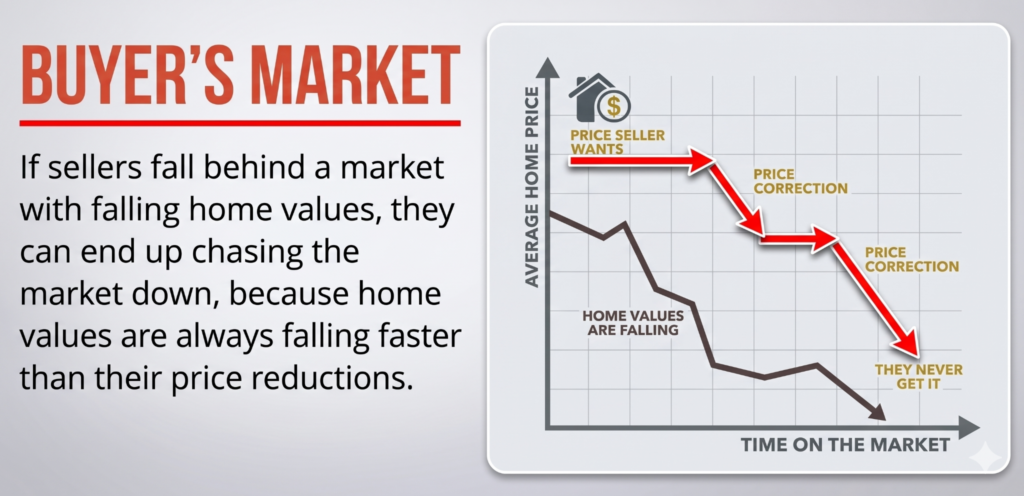
There is another dynamic happening right now that is quietly influencing pricing across neighborhoods, and many agents are missing it. Sellers who must sell are driving the market.
These are the sellers who have already purchased another home, are relocating, facing financial pressure, or simply need certainty. They are not testing the market. They are acting decisively. They are pricing aggressively, offering concessions, and in many cases, giving up the “free equity” they gained over the past few years.
When these under-priced homes sell, they do more than just close a transaction. They create new comparable sales that influence every other listing in the area. They set new expectations for buyers. They force competing sellers to adjust their price also.
This is how markets shift. And if you’re not paying attention to these motivated sellers, you will find yourself chasing the market down instead of leading it. To lead the market you must show your seller how to get ahead on price so you get sold before the next incremental drop.
Understanding the 2026 Pricing Trend
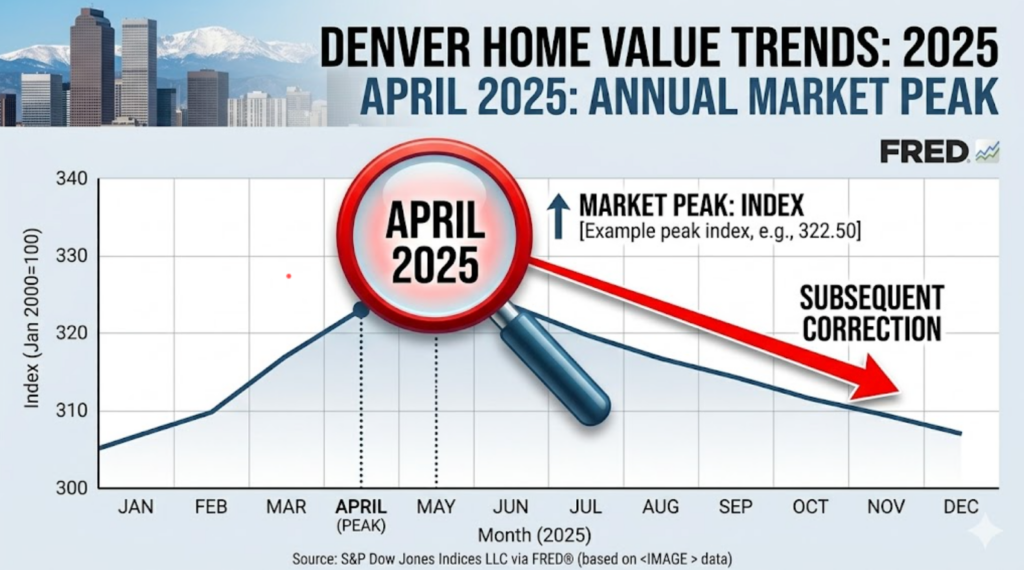
If 2026 follows the pattern we saw in 2025, there is a very important trend you need to understand and communicate. April was the peak of home prices in 2025. From April 2025 and beyond, we saw an increase in inventory, a slowdown in buyer activity, and a rise in price reductions.
I believe 2026 is likely going to follow that same pattern, and this creates a different environment for sellers who are entering the market later in the year. This is one of the most important strategic recommendations you can make:
“If you wish to sell in 2026, you should be pricing below the most recent comparable sales from now through January 2027, or until market conditions change.”
This is not about undervaluing their home. It is about staying ahead of a shifting market. Because in a market that is softening, yesterday’s price is often higher than today’s value, and today’s value may be higher than tomorrow’s.
The sellers who understand this early are the ones who sell faster and for more favorable terms. The ones who resist it often end up reducing later, after losing momentum.
Your Role Has Changed: From Order Taker to Advisor
In the previous market, agents could get away with saying yes to everything. If a seller wanted to price high, you could agree, put the sign in the yard, and let the market do the work. That approach does not work anymore.
Today, your role is to guide, not to follow. Your value comes from your ability to interpret the market, communicate what is actually happening, and help your seller make informed decisions. This is not always easy. In fact, it often requires you to have uncomfortable conversations.
But those conversations are where trust is built.
Because the seller doesn’t need another agent to tell them what they want to hear. They need someone who can help them achieve the result they want. Here’s how you do it:
The Data You Must Show Every Seller
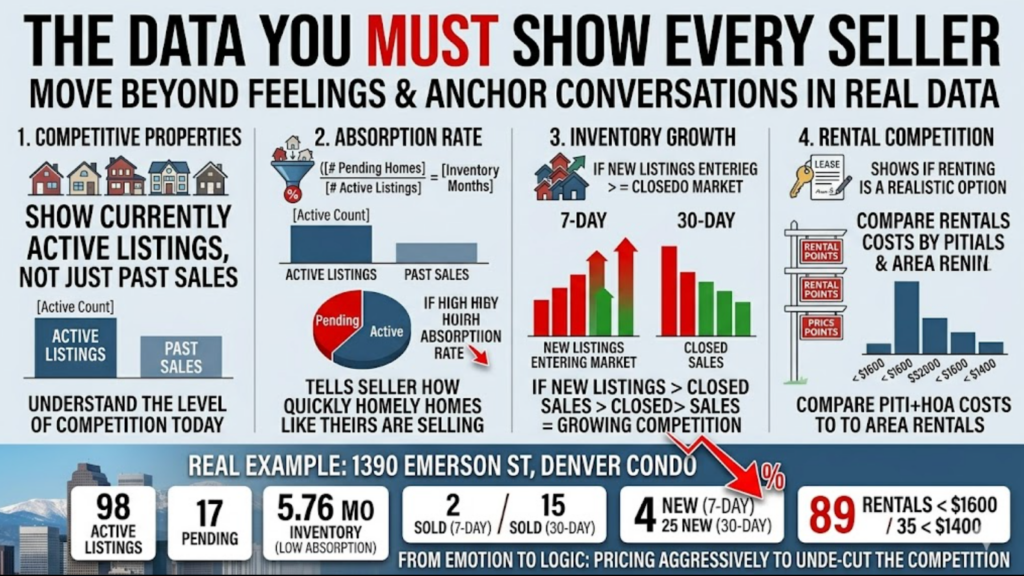
To effectively guide your sellers, you need to move beyond your feelings of opinions and anchor your conversations in real data. When you present the right information, the conversation becomes clear and objective.
Competitive Properties
Instead of leaning on past sales, show your sellers how many competitive properties, to theirs, are currently active on the market. This helps them understand the level of competition they are facing.
Absorption Rate
Next, show them how many of those homes are currently pending. When you compare the number of pending homes to the number of active listings, you create what is known as the Absorption Rate. This tells your seller how quickly homes like theirs are actually selling. If there are 20 comparable homes for sale and 4 are selling each month then there is 5-month’s of inventory.
Inventory Growth
From there, review how many competitive properties have closed in the past 7-days and the 30-days. and the number of new listings entering the market over the past week and the past month. This tells you whether inventory is growing or shrinking. If inventory is increasing faster than homes are selling, your seller is facing more competition in the future than they are today.
Rental Competition
Finally, introduce the concept of rental competition. Show how many homes are available for rent in the area at different price points. Seller’s often say that if they can’t sell it for what they want then they will just rent it. So share with them the current rental data so they can see if this is a realistic option.
When you walk your seller through this data, you are no longer debating price. You are showing them reality.
A Real Example: What the Numbers Actually Tell Us
Let’s take a real-world example to bring this to life. Consider a recent Denver condo listing of mine at 1390 Emerson Street. In this case, there are 98 other active listings competing for attention, while only 17 are pending. That creates a low Absorption Rate of 5.76 months of inventory. Meaning homes are NOT selling quickly.
Only two condos have sold in the past 7-days, and 15 over the past 30-days. At the same time, 4 new listings continue to enter the market, and 25 new listings in the past month. This tells a very clear story. There is more competition than demand, and that competition is growing! As we learned in Econ 101;
“When supply exceeds demand…. prices fall!”
Now layer in rental data, where there are 89 other condos for rent available under $1,600 per month and 35 under $1,400. With the seller’s PITI+MI+HOA of over $2700 a month the option to rent and lose $1000 a month was off the table.
See, when a seller sees this data presented clearly, it changes the conversation. It shifts from emotion to logic. It creates understanding. In this case he decided to get on the market quickly and cut his losses and price it aggressively to under-cut the competition to ensure that the few buyers that are out there for a Denver condo considers his first!
The Opportunity in This Shifting Market
It’s easy to look at a shifting market and see challenges. But the reality is, this is where opportunity is created. When the market was moving quickly, almost anyone could succeed.
Today, success requires skill. It requires discipline. It requires the ability to communicate clearly and guide effectively. While many agents are avoiding difficult conversations, overpricing listings, and hoping for a different outcome, you have the opportunity to do something different. You can become the advisor your clients actually need.
If you want help refining your pricing conversations, learning how to present this data effectively, or building a strategy that helps your sellers succeed in today’s market, let’s connect. Schedule a Strategy Session with me and I’ll walk you through exactly how to apply this approach so you can win more listings and close more deals in 2026.
